
SRE consulting helps businesses make their production systems more reliable using site reliability engineering, a discipline that treats operations as a software problem. In practice, that means defining what "reliable enough" means for each service, measuring it, building the monitoring and automation to protect it, and running a calm, repeatable incident process when something goes wrong.
Site reliability engineering was developed at Google and is described in detail in Google's free Site Reliability Engineering book. IS&T applies those principles at a scale that suits mid-sized businesses and growing software companies in Houston and across the US, either as a consulting engagement or as an ongoing managed SRE service.
Incidents feel chaotic and reliability targets are guesswork? Make reliability measurable.
When SRE Makes Sense
SRE is most valuable when:
- Customers depend on your application and notice when it's slow or down.
- You've made reliability promises in contracts, but you aren't measuring them precisely.
- Incidents are handled differently every time, depending on who's awake.
- Alerts fire constantly, so real problems get lost in the noise.
- Developers and operations disagree about whether to ship new features or fix stability.
Core SRE Practices We Put in Place
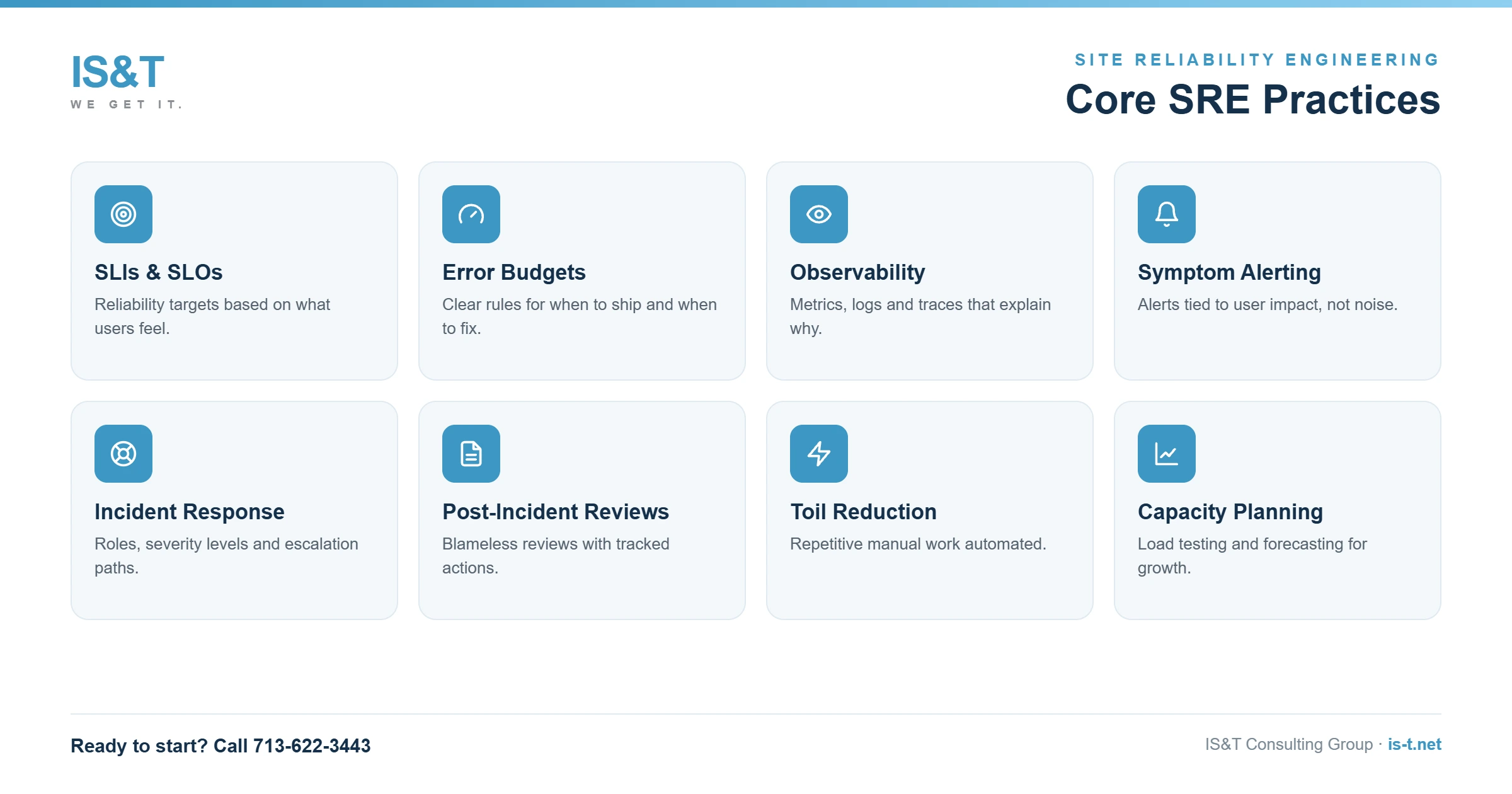
- Service level indicators and objectives (SLIs and SLOs) - We identify what users actually experience, such as request success rate or page load time, and agree on a target for each service.
- Error budgets - The gap between your SLO and perfection becomes a budget. When it's healthy, ship faster. When it's spent, focus on reliability. It turns an argument into a rule.
- Observability - Metrics, logs and traces that explain why a service is degraded, not just that it is.
- Alerting on symptoms - Alerts tied to SLOs and user impact, so on-call engineers are woken for real problems only.
- Incident response - Clear roles, severity levels, communication templates and escalation paths.
- Blameless post-incident reviews - Written reviews focused on fixing systems and processes, with tracked follow-up actions.
- Toil reduction - Automating repetitive manual tasks so engineers spend time on improvements.
- Capacity planning - Load testing and forecasting so growth doesn't arrive as an outage.
SRE Consulting vs Managed SRE
| SRE consulting | Managed SRE | |
|---|---|---|
| What you get | Assessment, SLOs, observability, incident process and training | Ongoing on-call, incident handling, SLO reporting and reliability work |
| Who runs production | Your team, with better practices and tooling | IS&T alongside your team |
| Typical duration | Two to four months | Monthly service |
| Best for | Teams with operations staff who need structure | Teams without the people to cover on-call and reliability work |
How an SRE Engagement Starts
- Reliability assessment - We review recent incidents, monitoring, alerting, on-call arrangements and architecture for your critical services.
- Define SLOs - Together with product and engineering leads, we set initial objectives for each critical service.
- Instrument - Dashboards and SLO tracking are built, and alerts are rewritten around user impact.
- Formalize incident response - Roles, runbooks and communication templates are put in place and practiced.
- Improve continuously - Post-incident reviews and error budget data drive a rolling list of reliability fixes.
Start With a Reliability Assessment
We review your incident history, monitoring and on-call setup, then define the service levels and practices that fit your systems.
SRE on Modern Platforms
Most of our SRE work runs on cloud platforms and containers. On Kubernetes, SRE builds on cluster operations from our managed Kubernetes services. Reliable releases also depend on solid pipelines, so SRE often pairs with managed DevOps, and we use the delivery measures from the DORA research program, including change failure rate and time to restore service, alongside your SLOs.
Reliability for Houston Businesses
IS&T has been a Houston-based IT partner since 1997 and has served more than 2,400 clients. Houston companies run systems where downtime has a direct cost: trading and scheduling platforms, logistics tracking, customer portals and SaaS products. Our team works with businesses across the Energy Corridor, Downtown and The Woodlands, as well as distributed teams elsewhere, and can run SLO workshops and incident simulations on site. For the broader picture of how we build and run software delivery, see our DevOps consulting services.
Frequently Asked Questions
What is SRE consulting?
SRE consulting helps a business apply site reliability engineering practices to its production systems. It typically covers defining service level objectives, improving monitoring and alerting, formalizing incident response, and reducing manual operational work.
What is the difference between SRE and DevOps?
DevOps is a broad approach to how development and operations teams work together to deliver software. SRE is a specific way of practicing it, with measurable reliability targets, error budgets and engineering-driven operations. Many teams use both.
What is an SLO?
A service level objective is a target for how reliably a service should perform, such as 99.9 percent of requests succeeding over 30 days. It is measured using service level indicators and guides decisions about when to prioritize reliability work.
What is managed SRE?
Managed SRE is an ongoing service where an outside team handles on-call, incident response, SLO reporting and reliability improvements for your production systems, working alongside your developers.
Do we need SRE if we already have monitoring?
Monitoring tells you something is wrong. SRE defines what "wrong" means from the user's point of view, decides how much unreliability is acceptable, and builds the process to respond and improve. Many teams with good monitoring still benefit from SLOs and structured incident response.
Make Reliability Measurable
If incidents feel chaotic or reliability targets are more hope than measurement, IS&T can help. Call IS&T at 713-622-3443 or request a proposal.