
DevSecOps services build security checks directly into the way software is written, built and deployed, so vulnerabilities are caught while they're still cheap to fix. Instead of a security review at the end of a project, automated scanning, secrets protection and policy controls run in the CI/CD pipeline on every change, and developers get findings in the tools they already use.
IS&T provides DevSecOps consulting and ongoing DevSecOps support for software teams in Houston and across the US. We focus on practical controls that reduce real risk without grinding releases to a halt, because security that developers work around doesn't protect anything.
Security reviews slowing releases or happening too late? Build security into the pipeline.
Why Security Belongs in the Pipeline
Traditional security reviews happen late, after code is written and deadlines are close. Findings at that stage are expensive to fix and easy to defer. DevSecOps shifts that work earlier:
- Code is scanned when it's committed, not months later.
- Vulnerable open source libraries are flagged before they reach production.
- Secrets like API keys and passwords are blocked from entering repositories.
- Cloud infrastructure is checked for misconfigurations before it's deployed.
- Every release leaves an audit trail showing which checks ran and what they found.
The NIST Secure Software Development Framework (SP 800-218) sets out these practices in detail, and it's increasingly referenced by customers and regulators when they ask how software is built.
Our DevSecOps Services
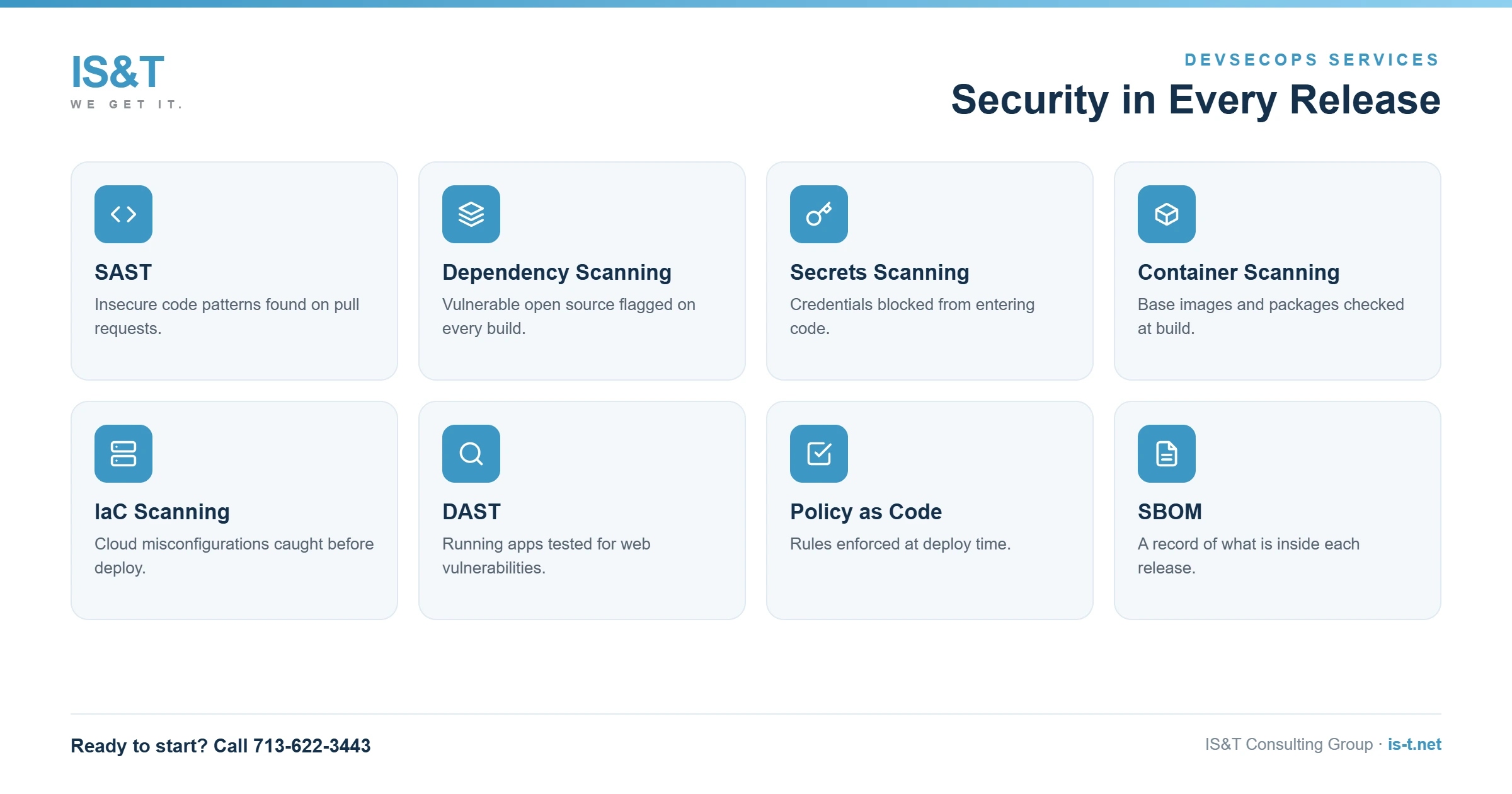
| Control | What it does | Where it runs |
|---|---|---|
| Static application security testing (SAST) | Finds insecure code patterns | On pull requests |
| Software composition analysis (SCA) | Flags vulnerable or risky open source dependencies | On every build |
| Secrets scanning | Stops credentials being committed to code | Pre-commit and in the pipeline |
| Container image scanning | Finds vulnerabilities in base images and packages | At build and in the registry |
| Infrastructure as code scanning | Catches cloud misconfigurations in Terraform, Bicep or CloudFormation | Before deployment |
| Dynamic testing (DAST) | Tests running applications for common web vulnerabilities | In staging |
| Policy as code | Enforces rules such as approved images or required encryption | At deploy time and in Kubernetes |
| Software bill of materials (SBOM) | Records what's inside each release | At build |
Beyond tooling, our DevSecOps consulting covers:
- Assessment - A review of your current pipeline, repositories and cloud setup against secure development practices, with a prioritized roadmap.
- Secrets management - Moving credentials into a managed vault such as AWS Secrets Manager, Azure Key Vault or HashiCorp Vault.
- Access control - Least-privilege access for pipelines, branch protection and signed commits where required.
- Triage and tuning - Reducing false positives so developers trust the findings and act on them.
- Compliance evidence - Pipeline records and reports that support audits and customer security questionnaires.
Making Security Developer-Friendly
The fastest way to fail at DevSecOps is to switch on every scanner and block every build. Developers drown in findings and start bypassing checks. We roll controls out in stages: report-only first, then blocking only for high-severity issues, with clear guidance on how to fix each one. Findings appear in pull requests, not in a separate portal nobody checks.
Part of a Broader DevOps Practice
DevSecOps works best on top of solid delivery foundations. If pipelines or infrastructure as code aren't in place yet, our DevOps consulting services build those first. For teams running containers, security controls extend into the cluster through our managed Kubernetes services, and teams without in-house DevOps staff can have these controls operated for them through managed DevOps.
DevSecOps for Houston Teams
IS&T has been a Houston-based IT partner since 1997 and has served more than 2,400 clients. Houston software teams often work inside regulated or high-risk industries such as financial services, energy, healthcare and logistics, where customers ask detailed questions about how software is secured. We work with teams across the Energy Corridor, Downtown and The Woodlands, as well as remote teams, and can run hands-on workshops with developers on site. The aim is always the same: fewer vulnerabilities reaching production, and clear evidence that your process works.
Start With a DevSecOps Assessment
We review your pipeline, tooling and current security checks, then show where automated controls fit without slowing developers down.
Frequently Asked Questions
What are DevSecOps services?
DevSecOps services integrate security into software delivery by adding automated checks, such as code scanning, dependency analysis, secrets detection and infrastructure scanning, to the CI/CD pipeline. They also cover the processes and training that help developers fix issues early.
What is the difference between DevOps and DevSecOps?
DevOps focuses on automating and speeding up software delivery. DevSecOps adds security to that same process, so checks run automatically on every change instead of in a separate review at the end.
Will DevSecOps slow down our releases?
It shouldn't, if it's introduced carefully. Most checks run in parallel with builds and take minutes. We start in report-only mode and only block releases for high-severity findings, so delivery speed is protected while risk falls.
Which DevSecOps tools do you use?
We work with tools built into GitHub, GitLab and Azure DevOps, plus established open source and commercial scanners for code, dependencies, containers and infrastructure as code. We recommend tools based on your platform, budget and existing setup.
Can DevSecOps help with compliance audits?
Yes. Pipelines record which security checks ran on each release and what they found, giving auditors and customers concrete evidence of secure development practices. This supports common security frameworks and customer security questionnaires.
Build Security into Every Release
If security reviews are slowing releases down or happening too late to matter, we can help you move them into the pipeline. Call IS&T at 713-622-3443 or request a proposal.