
Cloud modernization services update legacy applications and infrastructure so they take full advantage of the cloud, rather than simply running old systems on rented servers. That can mean moving a database to a managed service, packaging an application into containers, breaking a large application into smaller services, or replacing custom code with cloud-native components that scale and patch themselves.
Many Houston businesses moved to the cloud by copying servers as they were. It was the fastest way out of an aging server room, and often the right first step. But it leaves the old problems in place: manual patching, fixed capacity, fragile deployments and costs that don't fall when usage does. IS&T's cloud modernization work tackles those problems application by application.
Moved to the cloud but still running it like a data center? See what modernization would change.
Signs an Application Needs Modernizing
- It runs on an operating system or framework that is out of support or close to it.
- Scaling means buying a bigger server, and peaks still cause slowdowns.
- Releases require downtime and a long manual checklist.
- The database server takes up a disproportionate share of your cloud bill and your admin time.
- Only one person understands how to deploy or fix it.
- New features take months because every change risks breaking something else.
Modernization Approaches
There's no single path. We choose the lightest approach that solves the real problem.
| Approach | What changes | Typical benefit |
|---|---|---|
| Replatform | Move to managed services, such as Azure SQL, Amazon RDS or Cloud SQL, with minimal code changes | Less maintenance, built-in backups and high availability |
| Containerize | Package the application into containers running on a managed platform | Consistent environments and simpler deployments |
| Refactor | Rework parts of the code to use cloud-native services | Better scalability and lower run costs |
| Re-architect | Split a monolith into smaller services or event-driven components | Independent scaling and faster feature delivery |
| Replace | Move to a SaaS product | No code to maintain for commodity functions |
The approach is chosen per application, and many modernization programs combine several. These categories line up with the migration strategies on our cloud migration services page, where modernization picks up after the initial move.
Our Cloud Modernization Services
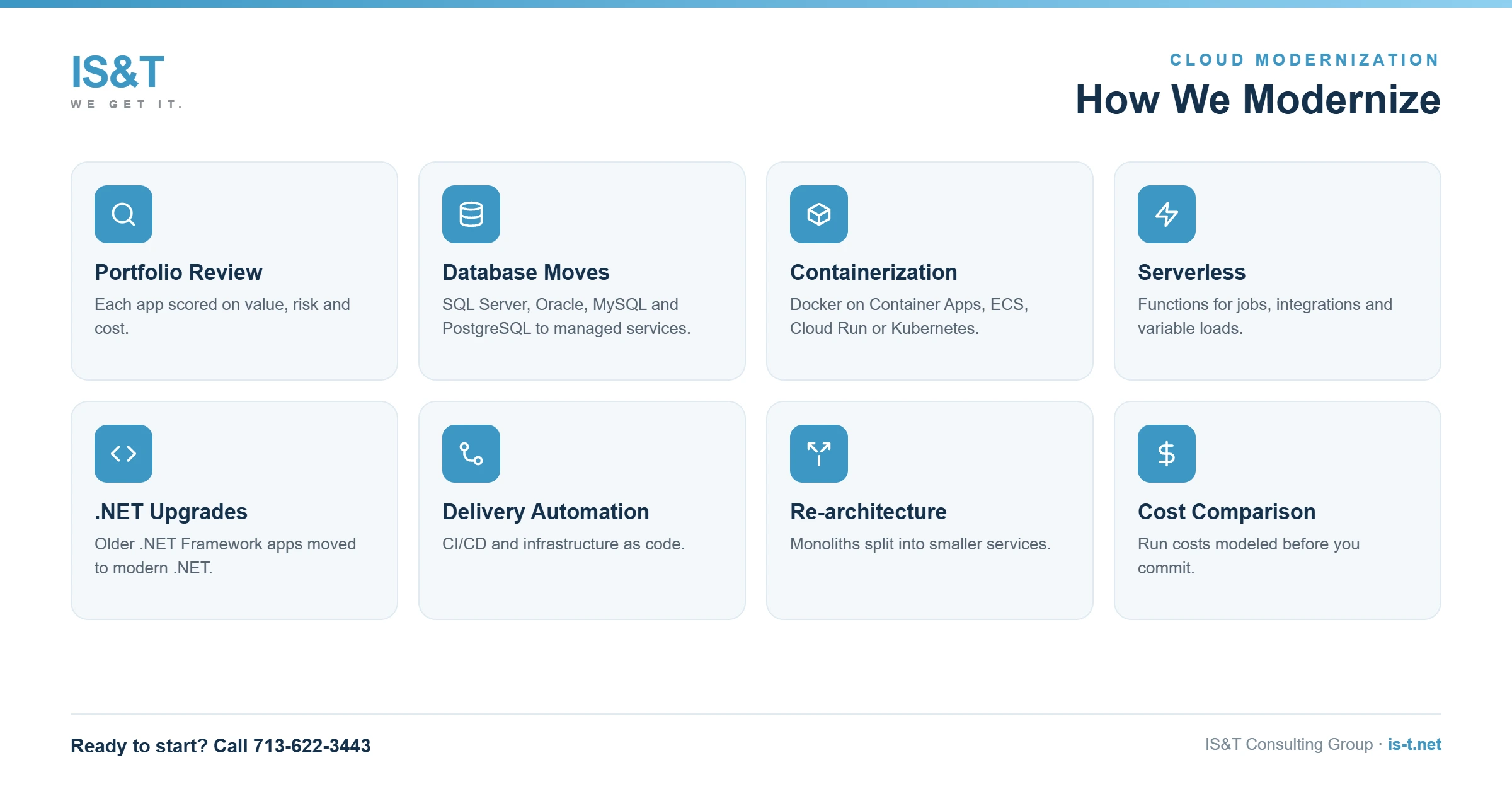
- Application portfolio review - We score each application on business value, technical condition, risk and cost, then recommend which to modernize first.
- Database modernization - Moving self-managed SQL Server, Oracle, MySQL or PostgreSQL to managed database services, with performance testing before cutover.
- Containerization - Packaging applications with Docker and running them on Azure Container Apps, Amazon ECS, Google Cloud Run or Kubernetes.
- Serverless and event-driven design - Using services like AWS Lambda, Azure Functions and Google Cloud Functions for scheduled jobs, integrations and variable workloads.
- .NET and legacy framework upgrades - Moving older .NET Framework applications to modern .NET so they run on Linux containers and current platforms.
- Delivery automation - CI/CD pipelines and infrastructure as code so modernized applications are released safely and often, built with our DevOps consulting team.
How a Modernization Program Runs
- Assess - Review the application portfolio, architecture, code health and costs.
- Prioritize - Pick a first application that offers clear value with manageable risk.
- Design - Define the target architecture, data migration approach and testing plan.
- Build incrementally - Modernize in stages, often running old and new side by side, so the business is never betting everything on one cutover.
- Cut over and optimize - Move traffic to the modernized version, retire the old components and tune for cost and performance.
- Repeat - Apply what was learned to the next application.
Start With a Modernization Assessment
We score each application for modernization value and effort, then give you a phased plan with projected cost and risk.
Each provider documents its own guidance for this work, including the AWS Well-Architected Framework, and we design to those standards so the result is supportable long term.
Modernization & Cost
Modernized applications are usually cheaper to run because they scale with demand, use managed services instead of always-on servers, and need less manual administration. Modernization itself is an investment, though, so we build a cost comparison for each application before recommending it. Our cloud cost optimization work helps measure the savings once the change is live.
Modernization for Houston Businesses
IS&T has been a Houston-based IT partner since 1997 and has served more than 2,400 clients. Houston has a lot of long-lived software. Trading, scheduling, field service and engineering applications built a decade or more ago still run important parts of many local businesses. Our team works with companies across the Energy Corridor, Downtown, Katy, Sugar Land and The Woodlands, and we understand that these systems can't simply be switched off for a rewrite. Incremental modernization keeps them running while they improve. For the full view of how we plan, move and run cloud systems, see our Houston cloud consulting services.
Frequently Asked Questions
What are cloud modernization services?
Cloud modernization services update legacy applications and infrastructure to use cloud-native capabilities such as managed databases, containers and serverless computing. The goal is lower maintenance, better scalability and faster, safer releases.
What is the difference between cloud migration and cloud modernization?
Migration moves workloads to the cloud, often with few changes. Modernization changes how those workloads are built and run so they benefit fully from the cloud. Many businesses migrate first, then modernize their most important applications over time.
How long does application modernization take?
Replatforming a database or containerizing an application can take a few weeks. Re-architecting a large application into smaller services can take several months and is usually done in stages. We estimate each application after an assessment.
Do we have to rewrite our applications to modernize them?
Usually not. Many applications can be replatformed or containerized with modest changes. Full rewrites are rarely the best option and are reserved for systems where the existing code can't be maintained.
Which applications should we modernize first?
Start with applications that are important to the business, expensive or difficult to maintain, and technically ready for change. A portfolio review scores each application so the first project delivers clear value with manageable risk.
Plan Your Modernization
If your cloud bill and your maintenance burden still look like they did before you moved, modernization is usually the next step. Call IS&T at 713-622-3443 or request a proposal.